
You have decided to run a Black Friday sale, and now you have to choose a number.
There is the average Black Friday discount your category ran last year, and there is the number your own margin can pay for. This guide gives you the first one to start from, then the calculation that turns it into the second, and a last check on whether the extra orders can realistically arrive.
Start from the averages, but treat them as a reference
Here is what large US retailers actually took off last season, by category and by subcategory. DataWeave tracked nearly 80,000 SKUs at Amazon, Walmart, Target, Macy’s, Home Depot, Sephora and other large retailers, separating what was already discounted through November from what was added during Black Friday week.
| Category | Discount through November | Added in Black Friday week |
|---|---|---|
| Apparel | 13.8% | +3.8% |
| Men’s clothing | 17.7% | |
| Women’s clothing | 17.5% | |
| Plus size clothing | +5.4% | |
| Kids’ clothing | +4.4% | |
| Consumer electronics | 14.6% | +2.6% |
| Audio and video | 17.5% | |
| Accessories | +2.9% | |
| Wearables | +2.9% | |
| Home and furniture | 13.9% | +1.7% |
| Bedding | 18.6% | +2.4% |
| Furniture | 16.4% | |
| Outdoor | 15.1% | |
| Kitchenware | +0.9% | |
| Health and beauty | 7.1% | +4.8% |
| Fragrance | 13.0% | |
| Hair care | 4.6% | +6.0% |
| Grocery | 5.2% | +1.5% |
| Household essentials | 6.9% | |
| Beverages | 6.7% | |
| Frozen foods | 3.3% | +1.0% |
| Meat and seafood | 1.4% | +1.0% |
Two things stand out. Most of the discounting has already happened before Black Friday week begins, and the categories are a long way apart: a hair care brand and a bedding brand are not running the same sale, because they are not working with the same margin.
If those figures are not enough to place yourself, two more BFCM benchmarks covered the same season. Adobe measured the deepest point each category reached rather than the average across it, and found electronics peaking at 30.9%, toys at 29.6%, apparel at 25.1%, sporting goods at 20.3% and furniture at 18.8% (Adobe Analytics). Klaviyo measured a stable cohort of 10,000 brands on its own platform and found an average BFCM discount of 26.2%, down from 29.1% the year before (Klaviyo).
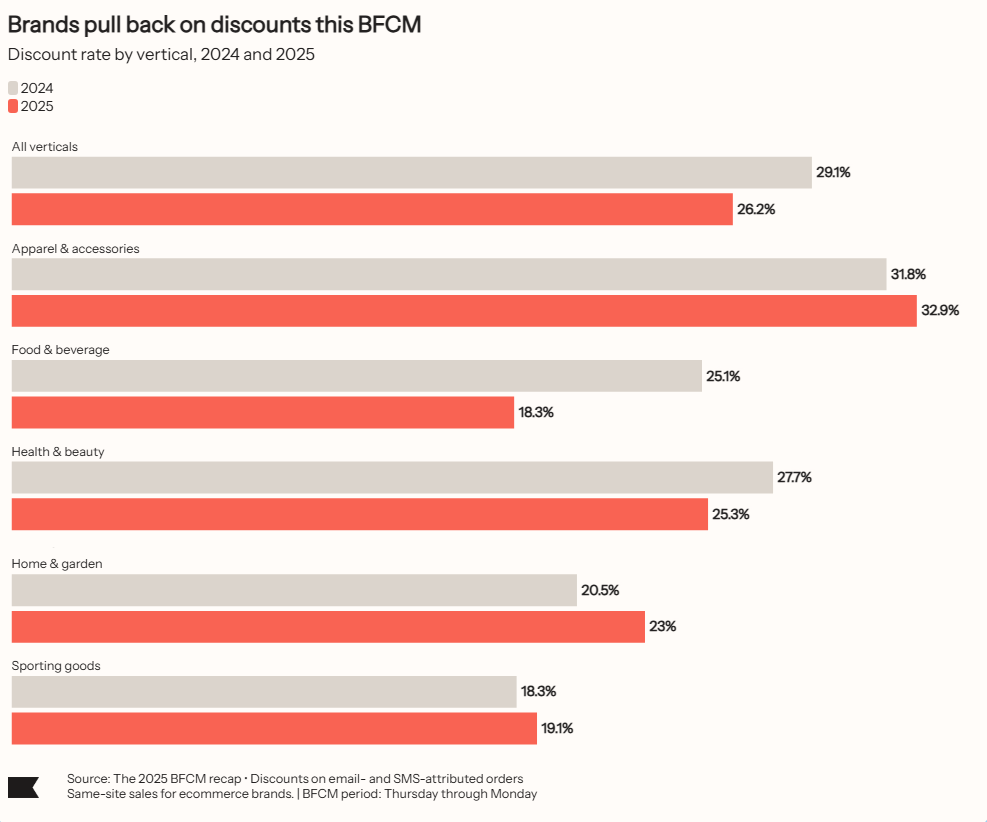
Find your own row across the three sources and you have a picture of what the industry treats as normal. Your customers will arrive expecting something close to it, so the number is worth knowing. But what your competitors could afford may not suit your business model, and the rest of this guide is about finding out whether it does.
Your costs are not the average’s costs
The store behind the 25% in the apparel row buys in different quantities, ships at a different rate, pays a different card fee, spends differently on advertising and loses a different share of its orders to returns. Copy its percentage onto your own product and the discount can take more than the product earns.
That is how a busy Black Friday ends with a smaller bank balance than a quiet one: the orders go up, every one of them loses money, and the loss only becomes visible in December when the returns land.
How much to discount on Black Friday is not a question the averages can answer for you, so take the number you just found and spend twenty minutes testing it against your own costs.
Work out what one order earns you today
Do this once for each group of products you plan to discount. One group is enough if the margins across it are close; if your bestseller earns 65% and the accessory beside it earns 30%, they are two calculations and two answers.
Subtract every cost the order carries, not only what the product cost
Five lines, and the last three are the ones usually left out.
- What the product cost you, landed — the invoice price plus duty and freight in, not the invoice price alone.
- Shipping out, at what you actually pay after any discount your carrier gives you.
- The payment fee, 2.9% plus 30¢ on Shopify’s Basic plan, 2.7% on Grow and 2.5% on Advanced.
- Returns, which cost you the shipping out, the shipping back, and the payment fee.
- Advertising — everything you spend on acquisition in a month, divided by the orders that month.
Notice that the payment fee appears twice. Shopify Payments does not give the processing fee back when you refund an order — “the original credit card transaction fee isn’t refunded to you when issuing a refund” — so a returned order refunds the customer in full and still leaves the fee with Shopify.
Your Shopify plan, your apps, your salaries and your rent stay out of the table altogether. None of them change when one more order arrives, so they answer whether the month paid for itself, not whether this discount does.
Take every figure from last year’s reports, not from this year’s plan
You can find landed cost in your product records, shipping on the carrier invoices, fees on the Shopify payouts page, the return rate in your returns report, and the ad spend in the ad accounts. A guessed input gives you a guessed answer, and the whole point of the exercise is to stop guessing.
The example running through the rest of this guide is a skin serum that sells for $45 and costs $15.75 landed. The store ships for $5, pays $4 to get a return back, loses 8 orders in every 100 to returns, and spent $8 per order on acquisition in an ordinary month. For the example we will count 100 orders at a time, so that returns come out in whole numbers.
| Per 100 orders at full price | |
|---|---|
| Money collected, 100 × $45.00 | $4,500.00 |
| Refunded on 8 returns | −$360.00 |
| Product cost on the 92 that stayed sold, 92 × $15.75 | −$1,449.00 |
| Shipping out, 100 × $5.00, and back, 8 × $4.00 | −$532.00 |
| Payment fees, 100 × (2.9% of $45.00 + 30¢) | −$160.50 |
| Advertising, 100 × $8.00 | −$800.00 |
| Profit | $1,198.50 |
| Per order | $11.99 |
Model the reference discount against your own numbers
Health and beauty took 7.1% off through November and another 4.8% during Black Friday week, so about 12% at its deepest. That is the reference for this store’s own category, and it is the first number to test.
The second is 25%. Apparel and electronics sell at that depth every year, and 25% is the figure most people picture when they think of a Black Friday sale. Worth checking whether this store can be that bold.
Four things change when the discount goes on, and three of them change less than people expect.
- The margin takes the whole discount. You lower the selling price, but none of your costs move with it, so the discount comes out of the margin and nowhere else. At 25% off, the serum’s $45 becomes $33.75 and the $15.75 it cost you stays exactly where it was.
- The payment fee falls a little. 2.9% of $33.75 plus 30¢ is $1.28 instead of $1.61. That does not help much, but it belongs in the table for fairness.
- Advertising goes up. November is the expensive month: across more than 33,000 stores measured by Triple Whale, Meta cost $22.26 per thousand impressions over BFCM 2025, up almost 8% on the year. Your own rise is in your own reports — compare your cost per order in November with October and use that ratio. The store in this example went from $8 to $10.
- Returns may move too. Pull your return rate for last November and December and compare it with your ordinary months. The National Retail Federation put returns at 19.3% of all US online sales in 2025, but the only rate that belongs in your table is yours, because it is the one that will happen.
| Per 100 orders | Full price | 10% off | 15% off | 25% off |
|---|---|---|---|---|
| Price | $45.00 | $40.50 | $38.25 | $33.75 |
| Money collected | $4,500.00 | $4,050.00 | $3,825.00 | $3,375.00 |
| Refunded on 8 returns | −$360.00 | −$324.00 | −$306.00 | −$270.00 |
| Product cost, 92 units | −$1,449.00 | −$1,449.00 | −$1,449.00 | −$1,449.00 |
| Shipping out and back | −$532.00 | −$532.00 | −$532.00 | −$532.00 |
| Payment fees | −$160.50 | −$147.45 | −$140.93 | −$127.88 |
| Advertising | −$800.00 | −$1,000.00 | −$1,000.00 | −$1,000.00 |
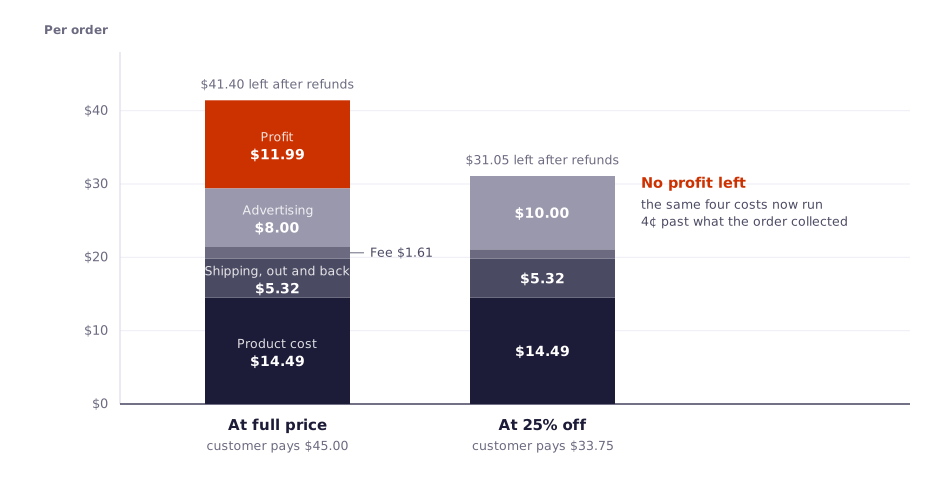
| Profit | $1,198.50 | $597.55 | $397.07 | −$3.88 |
| Per order | $11.99 | $5.98 | $3.97 | −$0.04 |
Move the percentage until the answer stops being near zero
Fifteen percent leaves $3.97 an order and ten percent leaves $5.98. Twelve percent, the figure the category actually ran, leaves $5.17. Selling without profit is not a business, so the number has to come up until the answer is one you would accept — and then one more question decides between the survivors.
Reality-check the volume the discount has to bring in
Profit per order is half the decision. The other half is whether enough extra business arrives to cover what each order gave up.
Work out how many orders the discount has to replace
Orders you need = profit per order before ÷ profit per order after
At 10% off the serum earns $5.98 instead of $11.99, so $11.99 ÷ $5.98 = 2.0. The sale has to bring in twice the orders to finish where it started.
| Discount | Profit per order | Orders needed to match full price |
|---|---|---|
| Full price | $11.99 | — |
| 10% off | $5.98 | 2.0× |
| 12% off | $5.17 | 2.3× |
| 15% off | $3.97 | 3.0× |
| 25% off | −$0.04 | no number works |
Compare that multiple with what your sale actually did last year
Open last November and count the orders over your sale dates against an ordinary week. If the weekend brought twice the orders, 10% off stands up and 15% does not. If it brought one and a half times, none of these columns pays for itself on its own.
At that point either the number comes down again, or the sale is doing a job other than making money this month — clearing stock you are paying to store, for example.
Count the full-price products that leave with the discounted one
A discounted product rarely leaves on its own. It brings someone to the store, and the order that follows often carries things that were never on sale — which is why a clearance list can pay for itself even when the clearance item barely does.
That second product goes into an order whose shipping and whose share of the advertising are already paid. A full-price $45 serum that cost $15.75 adds about $28 to the same order before returns, against the $3.97 the discounted one earns. Seven times as much, for a unit you did not discount at all.
To see how much of this your store does, open last November again and look at what the orders contained. Compare the average order value over your sale dates with an ordinary week, count the products per order in both, and check how much of each sale order was sold at full price. If your sale orders were half again as large as your normal ones, the table above is your worst case rather than your answer, and you can carry a deeper discount than it suggests.
Count the orders that cost nothing to bring in
One more line moves in your favour. The advertising figure is an average across every channel, so orders arriving from your own email and SMS lists cost almost nothing and pull it down. A store whose extra Black Friday orders come from a list it spent October building can carry a deeper discount than the same store buying the same orders cold — which is the whole argument for growing the list before the season starts.
Protect the number you chose
A percentage that clears the calculation can still leak on the way to the checkout. Three checks before the campaign goes live.
Give the smaller discount to your regulars and the larger one to new customers
Three field experiments run with a catalogue retailer, tracked over two years, found that deep discounts sent to established customers left them buying less afterwards: their future revenue fell to $584.68 against $733.50 for the shallower offer, a drop of about 20%. The same deep discounts sent to first-time buyers raised their later purchases (Anderson & Simester, Marketing Science).
So the headline number goes on the offer aimed at people who have never bought from you. Your regulars get early access and a smaller cut, which costs you less and works better.
Do not allow unwanted double discounts
This is the problem store owners run into year after year. Shopify lets a discount code apply to a product that already carries a reduced price, even when you have forbidden combinations in the code’s own settings. The Combinations section governs how one discount meets another discount; a lowered price is not a discount as far as Shopify is concerned, so nothing there stops the pair.
Left unprepared, that can turn into a large problem over one weekend — the percentage you tested becomes a percentage on top of a sale price, on the orders you least expected. The functional gap needs an outside app such as Alpha Sale, which blocks the coupon on items that already carry a sale price, or applies whichever of the two is larger so the customer gets the better one and never both.
Our complete guide to Shopify discounts goes through the rest of the combination rules.
Cap what one large order can take off
A percentage has no upper bound. Fifteen percent takes $6.75 off a $45 order and $67.50 off a $450 one. Shopify’s discount screen has no field for a maximum amount: its Maximum discount uses section holds a total usage limit and one use per customer, and nothing else. Our guide to creating a discount code in Shopify goes through that screen field by field.
Inside Shopify there are two ways round that. A fixed amount caps itself, because $20 off is $20 whatever the cart holds, but it then looks small on the small orders. A second discount aimed at one narrow collection limits what the percentage can reach in the first place.
Black Friday discount FAQ
What is the average discount on Black Friday?
It depends on the category and on who is counting. Across large US retailers in 2025, apparel averaged 13.8% through November and 3.8% more in Black Friday week, health and beauty 7.1% and 4.8%, grocery 5.2% and 1.5%. Measuring the deepest point instead of the average, Adobe put electronics at 30.9% and apparel at 25.1%. Among 10,000 smaller brands on Klaviyo the average was 26.2%.
How much should I discount on Black Friday?
As much as your own numbers allow and no more. Work out what one order earns you after product cost, shipping, payment fees, returns and advertising, then recalculate it at the discount you are considering. If the answer is near zero, the percentage is too deep whatever your category did.
Is 25% off too much?
That depends on your category and on your own numbers, and no article can answer it for you. Electronics and apparel advertise 25% and deeper every year; beauty and grocery rarely pass 12%. Put 25% into the table above with your own costs in it and look at what one order is left earning — if that figure is near zero or below it, the answer is yes.
Do I need to include returns in the calculation?
Yes, and they hurt more than most owners expect. A returned order gives back the product but keeps the shipping both ways and the payment fee, which Shopify does not refund. At a 20% return rate that cost lands on every fifth order and it does not shrink when you discount.
Should I count the full-price items that sell alongside the discounted one?
Yes — leaving them out is the most common reason a workable discount looks unworkable on paper. The discounted item brings someone to the store, and the rest of the basket arrives at full price into an order whose shipping and advertising are already paid for. Check your average order value and products per order over last year’s sale dates against an ordinary week; if the sale orders were larger, you can carry a deeper discount than the single-item table suggests.
Do deeper discounts bring in more revenue?
Revenue, often. Profit, only if the volume multiplies rather than rises. Halving what an order earns means the sale needs twice the orders to stand still, and last November’s figures will tell you whether your store has ever done that.
Choosing a Black Friday discount looks like a marketing decision and is really an arithmetic one with a marketing headline on top. The table takes twenty minutes and it answers a question your competitors are mostly guessing at, which is a better position to enter the weekend from than a number copied off somebody else’s banner.
If the part you are dreading is the setup — discounting a catalogue at once, capping what a single order can take, keeping coupons off what is already reduced, and putting every price back on the Tuesday — Alpha Sale does those on a schedule. There is a free plan to try it on this year’s campaign, and you can read the reviews on the Shopify App Store.